

Orforglipron Research Capsules | Oral Non-Peptide GLP-1 Receptor Agonist
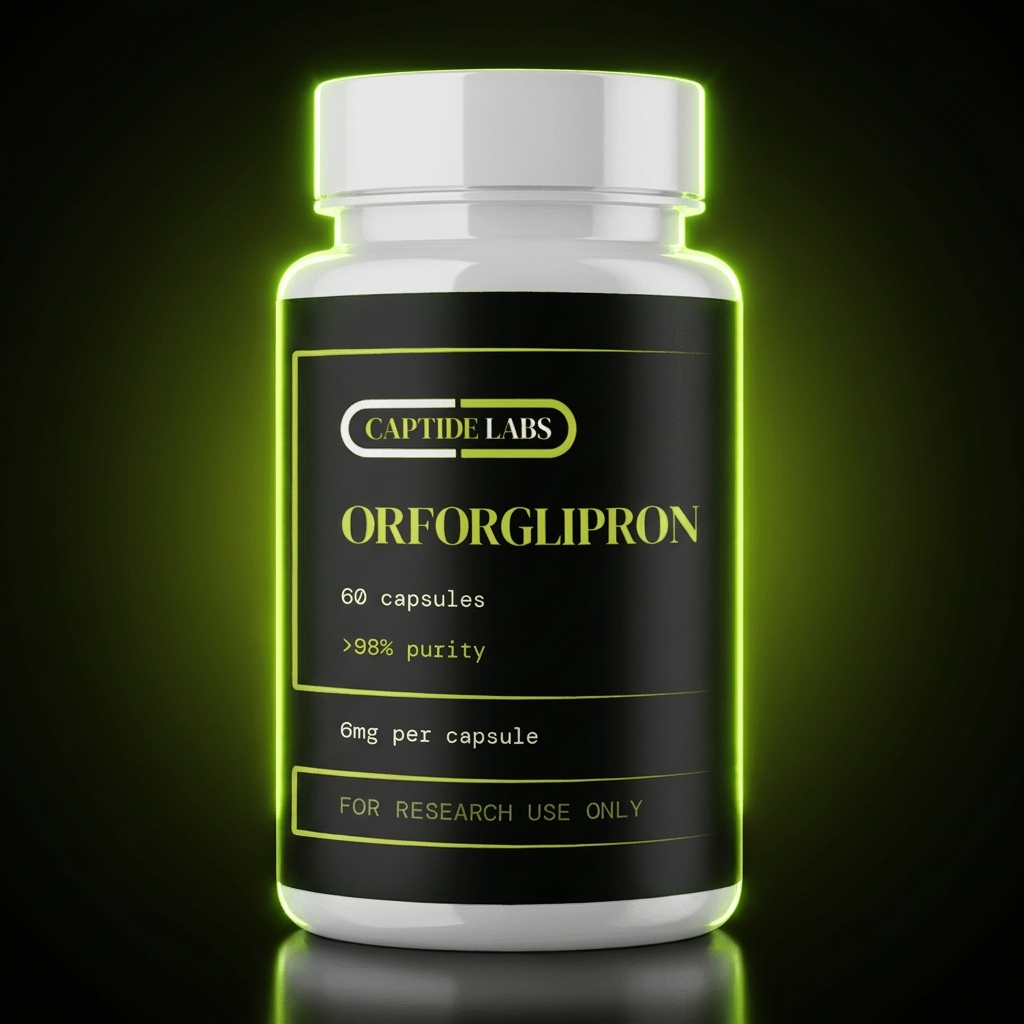
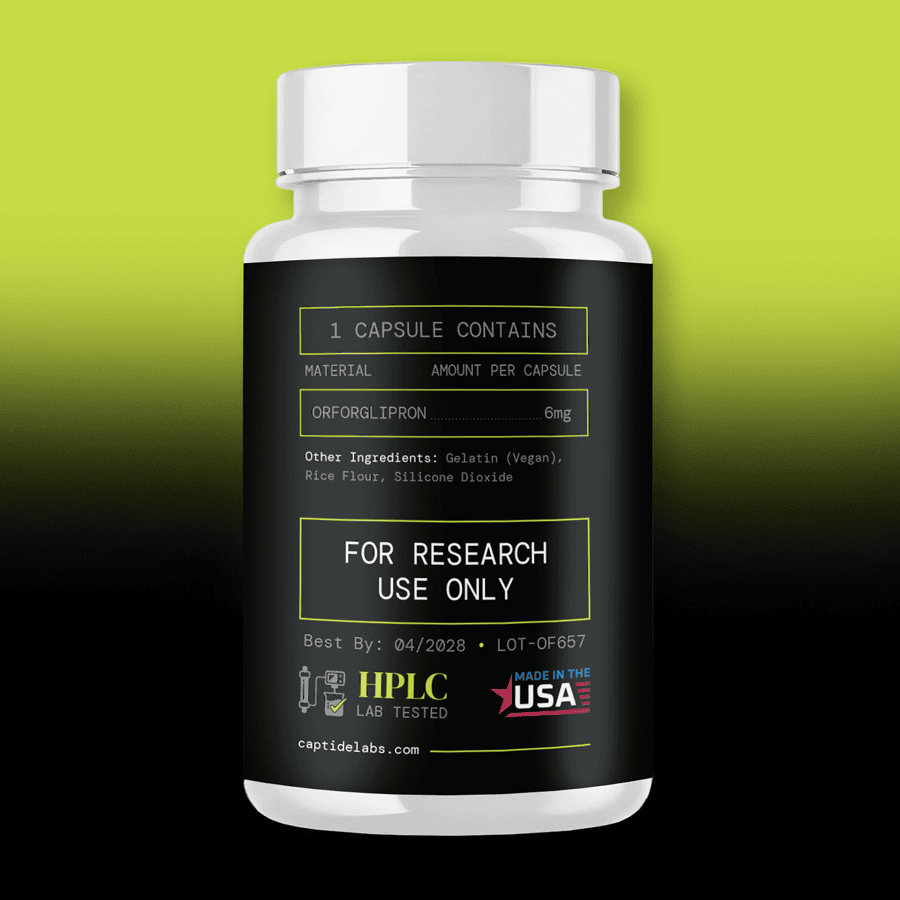
Captide Labs Orforglipron capsules provide researchers with a precisely dosed, encapsulated format of one of the most significant small-molecule GLP-1 receptor agonists to emerge from contemporary metabolic drug research. Each capsule delivers 6mg of Orforglipron at greater than 98% purity, independently verified by HPLC-MS analysis and documented with a full Certificate of Analysis.
Orforglipron (CAS 2212020-52-3, development codes LY3502970 and OWL833) is a non-peptidic, orally bioavailable small-molecule partial agonist of the glucagon-like peptide-1 (GLP-1) receptor — biased toward G protein activation over β-arrestin recruitment. Originally discovered by Chugai Pharmaceutical and subsequently developed by Eli Lilly, it received FDA approval for chronic weight management under the brand name Foundayo. Unlike peptide-based GLP-1 agonists which require injection or complex absorption-enhancing co-formulations, Orforglipron is orally bioavailable without food or water restrictions — a property that has made it a subject of intense clinical and preclinical research interest in obesity, type 2 diabetes, and cardiometabolic disease.
What is Orforglipron?
Orforglipron is a non-peptidic small molecule that acts as a partial agonist at the glucagon-like peptide-1 (GLP-1) receptor. GLP-1 is an incretin hormone secreted by intestinal L-cells in response to food intake, playing central roles in glucose-dependent insulin secretion, glucagon suppression, gastric emptying, and appetite regulation via central nervous system pathways. Structural studies by cryogenic electron microscopy (Kawai et al., PNAS 2020) have demonstrated that Orforglipron binds within the upper helical bundle of the GLP-1R — a binding site distinct from the orthosteric site occupied by peptidic agonists.
What distinguishes Orforglipron from earlier GLP-1 receptor agonists such as semaglutide and liraglutide is its small-molecule, non-peptidic structure — enabling oral bioavailability without the formulation complexity required for oral peptide delivery (e.g. the SNAC absorption enhancer used in oral semaglutide). Pharmacologically, it is a biased agonist favoring G protein activation over β-arrestin recruitment, with reported EC50 values in the low nanomolar range (~0.5–1 nM) in cAMP accumulation assays. It has advanced through Phase 3 clinical trials in type 2 diabetes and obesity, including the ACHIEVE-3 head-to-head trial against oral semaglutide (2026, published in The Lancet), and received FDA approval for chronic weight management.
Areas of Active Orforglipron Investigation
GLP-1 Receptor Pharmacology & Biased Agonism
As a partial GLP-1R agonist biased toward G protein activation over β-arrestin recruitment, Orforglipron has become an essential tool for studying signaling bias at class B G protein-coupled receptors. Researchers have compared its pharmacological activity against peptidic GLP-1 agonists to characterize differences in receptor engagement, cAMP signaling cascades, receptor internalization kinetics, and downstream β-cell and neuronal responses.
Glucose Regulation & Insulin Secretion
Clinical trials have demonstrated significant reductions in HbA1c in type 2 diabetes patients, consistent with GLP-1 receptor agonism driving glucose-dependent insulin release and glucagon suppression. The ACHIEVE-3 trial (Lilly, 2026) reported superior glycemic control versus oral semaglutide. Preclinical models have examined the cellular mechanisms underlying these glycemic effects in pancreatic beta cell culture systems and isolated islet preparations.
Body Weight & Appetite Regulation
Phase 2 and Phase 3 clinical data have shown substantial body weight reductions in obese and overweight subjects, driven by GLP-1 receptor-mediated appetite suppression via hypothalamic pathways and delayed gastric emptying. Researchers have investigated the CNS mechanisms underlying the anorectic effects of small-molecule GLP-1 receptor agonism, with particular focus on how non-peptide ligands access central GLP-1 receptors compared to peripheral-only effects of peptidic agonists.
Cardiovascular & Cardiometabolic Research
GLP-1 receptor agonists as a class have demonstrated cardiovascular risk reduction in outcome trials. Orforglipron’s cardiovascular effects are under active investigation in dedicated outcome trials. Preclinical researchers have examined GLP-1 receptor expression in cardiac tissue and the direct cardioprotective signaling pathways activated by agonism, as well as effects on blood pressure, lipid profiles, and inflammatory cardiometabolic markers.
Oral Bioavailability & Small-Molecule GLP-1 Agonism
A key area of research interest is Orforglipron’s non-peptidic structure and oral bioavailability without food or water restrictions. Researchers have studied its absorption, distribution, metabolism, and excretion (ADME) profile (Ma et al., Diabetes Ther 2024), as well as structure-activity relationships that enable small-molecule GLP-1 receptor activation — insights with broad implications for next-generation GLP-1 drug discovery and structural biology of class B GPCRs.
NASH & Hepatic Metabolic Research
GLP-1 receptor agonism has been investigated for effects on non-alcoholic steatohepatitis (NASH) and hepatic lipid metabolism. Orforglipron’s oral bioavailability profile makes it a candidate tool compound for studying chronic GLP-1R activation in liver disease models, with researchers examining its effects on hepatic steatosis, inflammation, fibrosis markers, and the broader cardiometabolic complications of metabolic-associated fatty liver disease (MAFLD).
Frequently Asked Questions
What is Orforglipron used for in research?
How is Orforglipron different from semaglutide?
What purity is Captide Labs Orforglipron?
What is the CAS number for Orforglipron?
What is biased agonism and why does it matter for Orforglipron?
How is the purity of Captide Labs Orforglipron verified?
For research use only. Not for human consumption, veterinary use, or food/agricultural applications. Not evaluated or approved by the FDA for use by individuals outside of approved clinical contexts. Not intended to diagnose, treat, cure, or prevent any condition. All purchases are made with the understanding that this compound is strictly for in-vitro research and laboratory use. See the full Research Use Only (RUO) Policy.
Reviews
There are no reviews yet.