
Available Products
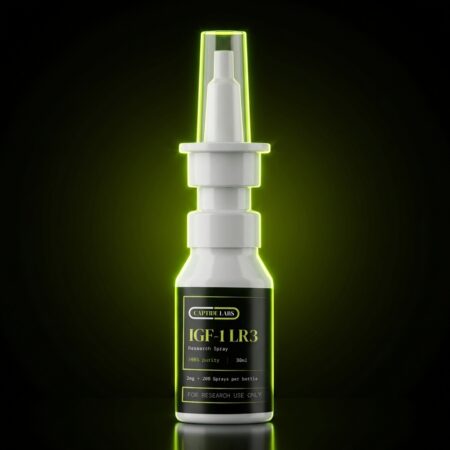
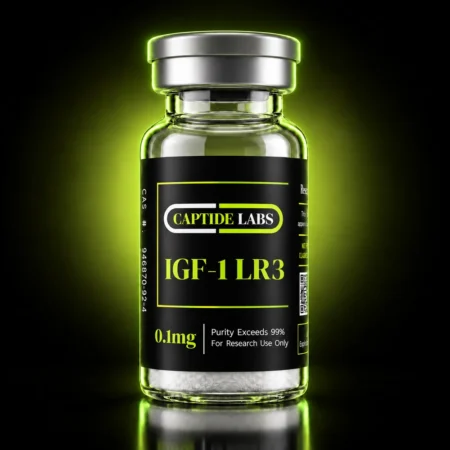
IGF-1 LR3 (Long Arginine-3 IGF-1, also written Long R3 IGF-1 or LR3-IGF-1) is a synthetic, lengthened analogue of human insulin-like growth factor 1 (IGF-1). It is an 83-amino-acid single-chain polypeptide, compared with the 70 residues of native IGF-1, and is catalogued under CAS number 143045-27-6, with a molecular formula of C₄₀₀H₆₂₅N₁₁₁O₁₁₅S₉ and a molecular weight of approximately 9117.6 g/mol (about 9.1 kDa). It differs from native IGF-1 in two engineered ways: an arginine substituted for glutamic acid at the third position (“arginine 3”), and an additional 13-amino-acid extension at the N-terminus (sequence MFPAMPLLSLFVN, the “long” modification). It contains three disulfide bonds, and its correct folding is a meaningful manufacturing-quality consideration for a peptide of this size.
IGF-1 LR3 has been used predominantly as a tool in cell-culture and developmental-biology research, where its potency and stability make it useful for studying IGF-1-receptor signalling. It is supplied here strictly as a research-use chemical for in vitro and laboratory investigation. It is not approved by the FDA, EMA, or any other regulatory authority for any indication.
Important note on the evidence base: IGF-1 LR3 is well characterized as a biochemical reagent and is widely used in cell-culture and stem-cell research, but there are no human clinical trials evaluating it as a therapeutic, and no long-term safety or carcinogenicity studies have been published. Because it was specifically engineered to bypass the body’s natural IGF-buffering system, its pharmacology raises particular safety considerations discussed below. Researchers should weight the evidence accordingly and consult the primary literature in the References section.
Mechanism of Action
The research literature on IGF-1 LR3 centers on its agonism at the IGF-1 receptor and on the structural modifications that distinguish it from native IGF-1. The pathways below are drawn from biochemical and preclinical work and have not been evaluated in human clinical trials of the analogue.
IGF-1 receptor agonism
IGF-1 LR3 retains the receptor-binding region of native IGF-1 and acts as an agonist at the IGF-1 receptor (IGF-1R), a receptor tyrosine kinase expressed on many cell types including muscle, bone, and other tissues. Receptor activation triggers two principal intracellular cascades: the PI3K/Akt pathway, associated with protein synthesis and cell survival, and the MAPK/ERK pathway, associated with cell proliferation [1].
Reduced IGFBP binding and extended half-life
The defining functional consequence of the two structural modifications is a dramatic reduction — reported as greater than 100-fold — in the analogue’s affinity for the insulin-like growth factor-binding proteins (IGFBPs). In the body, IGFBPs normally sequester native IGF-1, limiting its free concentration and shortening its functional life to minutes. By largely evading this buffering system, IGF-1 LR3 achieves a much longer functional half-life (reported on the order of 20 to 30 hours) and greater systemic exposure per unit administered, which is the principal reason it is used as a research reagent in place of native IGF-1 [2].
Cell-growth and differentiation endpoints
In culture systems, IGF-1 LR3 is used to drive proliferation and differentiation across several cell lineages, including applications in stem-cell research and cell manufacturing. In skeletal-muscle research models, IGF-1R activation has been associated with satellite-cell activity and with both hypertrophic and proliferative responses [1].
Oncogenic-risk consideration
This consideration warrants particular emphasis for IGF-1 LR3. The IGF-1R signalling axis is one of the most extensively studied pathways in cancer biology, and IGFBPs function in part as a natural buffer limiting IGF-1-driven proliferation and survival signalling. Because IGF-1 LR3 was specifically engineered to bypass that buffering mechanism while sustaining receptor activation, its pharmacology raises a substantive theoretical concern regarding promotion of cell proliferation with repeated or chronic exposure. No long-term carcinogenicity studies of IGF-1 LR3 have been published. This is a significant consideration for any research use [3].
None of the mechanisms summarized here have been evaluated for safety or efficacy in human clinical trials of IGF-1 LR3.
Forms and Use in the Research Literature
The information below reflects how IGF-1 LR3 appears in the published literature. It is reported strictly for research-reference purposes and does not constitute administration recommendations of any kind.
Cell-culture and stem-cell models. A major established use of IGF-1 LR3 is as a supplement in cell-culture media and stem-cell or cell-manufacturing workflows, where its potency and stability support proliferation and differentiation of ectodermal and mesodermal lineages. This in vitro reagent role is the compound’s best-documented application [1].
Developmental and metabolic models. Animal studies have used Long R3 IGF-1 to examine IGF-1-axis effects on growth, plasma growth-hormone dynamics, and tissue-specific metabolic endpoints, taking advantage of its extended exposure relative to native IGF-1 [2].
Capsule format. This product is supplied by Captide Labs in capsule form, consistent with the brand’s capsule-first catalog. Researchers should note that as a ~9 kDa protein with three disulfide bonds, IGF-1 LR3 is sensitive to degradation, and the published literature predominantly used parenteral or in vitro delivery; oral or encapsulated delivery represents a distinct research variable, and systemic bioavailability by this route is not characterized.
Stability and storage. IGF-1 LR3 is supplied as a lyophilized powder and is typically stored frozen, protected from light, with reconstituted solutions kept cold and used promptly to limit degradation and misfolding. As a larger disulfide-bonded protein, it is more demanding to manufacture and handle than small synthetic peptides. Each lot supplied by Captide Labs is accompanied by a batch-specific Certificate of Analysis documenting identity and purity by HPLC.
Adverse-event profile. No human clinical-trial adverse-event database exists for IGF-1 LR3. The known pharmacology of IGF-1R activation, the analogue’s engineered evasion of IGFBP buffering, and the documented adverse effects of recombinant native IGF-1 therapy together make the oncogenic-risk consideration described above especially relevant. Safety in humans has not been established, and long-term and carcinogenicity data are absent.
References
- Laron Z. Insulin-like growth factor 1 (IGF-1): a growth hormone. Mol Pathol. 2001;54(5):311–316. doi:10.1136/mp.54.5.311 · PubMed: 11577173
- Tomas FM, Lemmey AB, Read LC, Ballard FJ. Superior potency of infused IGF-I analogues which bind poorly to IGF-binding proteins. J Endocrinol. 1996;150(1):77–84. doi:10.1677/joe.0.1500077 · PubMed: 8708565
- Pollak M. Insulin and insulin-like growth factor signalling in neoplasia. Nat Rev Cancer. 2008;8(12):915–928. doi:10.1038/nrc2536 · PubMed: 19029956