Establishing a rigorous research methodology is fundamental to evaluating the stability and in vitro behavior of non-invasive peptide delivery systems. As investigators increasingly transition from traditional lyophilized powders to pre-formulated options, understanding the analytical parameters of these formats is critical. This guide outlines key protocols for assessing capsule- and spray-format BPC-157 and TB-500 blends under strict laboratory conditions.
Analytical Integrity and Reconstitution-Free Formats
In contemporary peptide chemistry, the transition from traditional lyophilized vials requiring manual reconstitution to pre-metered, non-invasive formats—such as capsules and intranasal sprays—has introduced new variables in experimental design. Traditional reconstitution protocols introduce inherent risks of pipetting errors, solvent contamination, and mechanical degradation of fragile disulfide bonds during manual agitation. By utilizing pre-formulated, reconstitution-free matrices, researchers can minimize operator-induced variance and significantly streamline high-throughput screening assays.
Evaluating these alternative matrices requires highly precise analytical validation. High-Performance Liquid Chromatography (HPLC) coupled with Mass Spectrometry (LC-MS) remains the gold standard for verifying the identity, purity, and concentration of active ingredients within these novel vehicles. For instance, when analyzing BPC-157 or TB-500 blends, establishing baseline chromatograms allows investigators to confirm that the excipients used in capsule shells or aqueous spray buffers do not interfere with the peak resolution of the target peptide sequence.

Establishing a Robust Research Methodology for Blend Assays
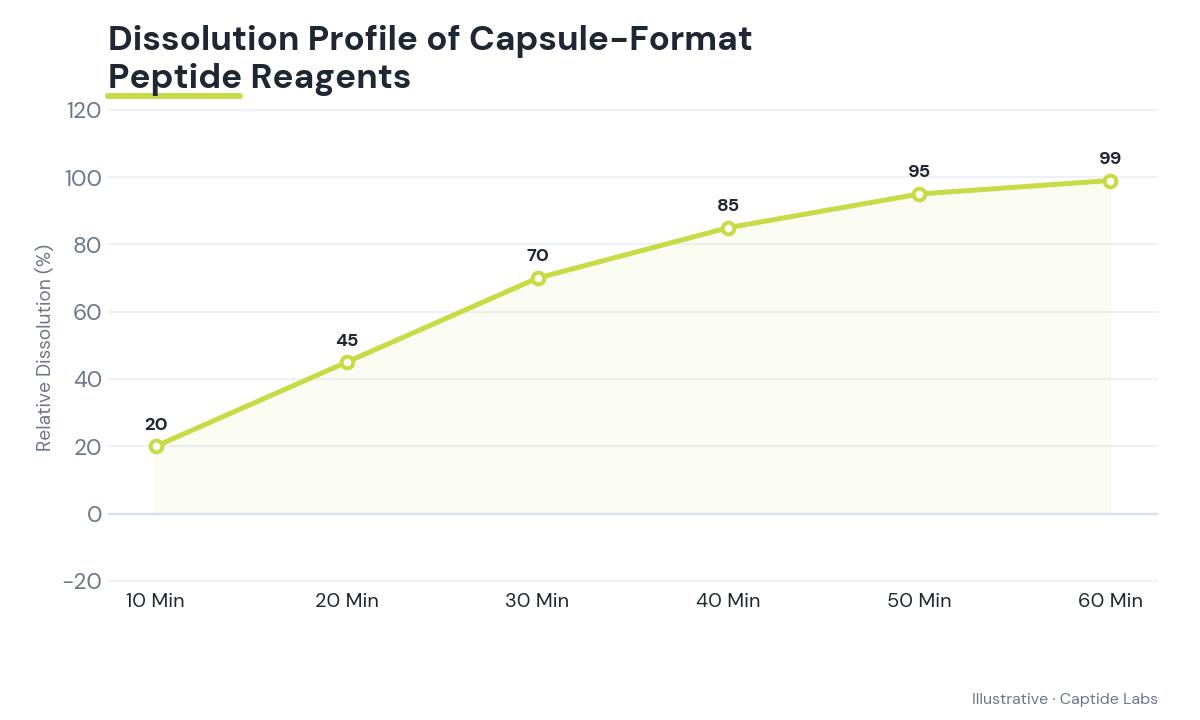
When designing an in vitro study involving blended peptide sequences, such as the synergistic combination of BPC-157 and TB-500, a structured research methodology must account for the distinct pharmacokinetic and pharmacodynamic profiles of each constituent. BPC-157, a pentadecapeptide, and TB-500, a synthetic fraction of Thymosin Beta-4, possess unique molecular weights and isoelectric points that dictate their behavior in solution. A robust methodology incorporates precise dissolution profiling to measure the rate at which these peptides release from capsule matrices under simulated physiological fluids.
To achieve reproducible results, researchers must utilize ISO 17025-certified reference standards to calibrate analytical instruments. Quantitative analysis should be conducted at predetermined intervals to plot release kinetics, ensuring that the blend ratio remains consistent throughout the simulated exposure window. This rigorous approach prevents confounding data that can arise from differential degradation rates of the individual peptides within the assay medium.

Standardizing Dissolution and Permeability Assays
For capsule-format research, dissolution testing represents a critical phase of the evaluation process. Utilizing USP dissolution apparatuses adjusted to specific pH levels allows investigators to simulate various localized environments. Measuring the concentration of intact BPC-157 and TB-500 over time via ultraviolet-visible spectroscopy or HPLC provides empirical data on the protective qualities of the capsule shell against enzymatic or acidic degradation.
Similarly, for spray-format peptides, aerosol deposition and droplet-size distribution must be characterized. The physical properties of the spray nozzle and the viscosity of the aqueous vehicle significantly influence the delivery efficiency and consistency of the dose. Investigators should employ laser diffraction techniques to quantify droplet size, ensuring that the physical characteristics of the spray remain stable across multiple actuations and storage conditions.
Quality Control and Purity Verification Standards
The validity of any laboratory investigation is directly dependent on the purity of the chemical reagents utilized. Third-party testing by independent, accredited laboratories provides unbiased verification of peptide purity, identity, and the absence of heavy metals or biological contaminants. For critical pathways such as tissue repair, cellular migration, or inflammatory response modulation, even minor impurities can alter cellular receptor binding and skew experimental outcomes.
Therefore, sourcing research-use-only (RUO) peptides that are accompanied by comprehensive Certificates of Analysis containing detailed HPLC and mass spectrometry data is paramount. This level of quality control ensures that the experimental data collected is a true reflection of the peptide’s biological activity, facilitating peer review and the scalability of the research findings.
From Captide Labs
Explore BPC-157 + TB-500 Blend Capsules from Captide Labs.

Frequently asked questions
What defines sound research methodology in peptide assays?
Sound research methodology in peptide assays involves standardized protocols, precise quantitative measurements using HPLC and LC-MS, and strict control of environmental variables to ensure reproducibility.
Why are HPLC and mass spectrometry critical for peptide research?
These analytical methods are critical because they provide definitive, third-party verifiable proof of peptide purity and molecular identity, confirming the absence of contaminants.
How do capsule-format peptides affect research methodology?
Capsule formats require researchers to integrate dissolution profiling and excipient-interference testing into their protocols to accurately measure the release kinetics of the active peptide.
Are Captide Labs products suitable for human clinical trials?
No, all Captide Labs products are strictly intended for laboratory research-use-only (RUO) and are not suitable or approved for human consumption or clinical trials.