ISO 17025 accreditation is the credential that separates a laboratory whose results can be trusted from one whose numbers are merely asserted, and for anyone evaluating research peptide testing it is among the most important details on a Certificate of Analysis. The term appears constantly in supplier marketing, usually with little explanation of what it actually means or why it should change your confidence in a set of test results. This guide unpacks the standard itself, what a laboratory must do to earn it, how accreditation differs from the certification people often confuse it with, and why it matters when you are deciding whether to trust the purity and identity data behind a compound.
Key Takeaways
- ISO 17025 is the international standard for the competence, impartiality, and consistent operation of testing and calibration laboratories.
- A lab is accredited to ISO 17025 by an independent accreditation body, not “certified.” A product cannot be “ISO 17025 certified.”
- ISO 17025 incorporates the management-system principles of ISO 9001 and adds technical competence specific to laboratories.
- Accreditation is scope-specific: a lab is accredited for particular methods, not for everything it might touch.
- On a peptide COA, an accredited testing laboratory turns reported purity and identity from claims into verified measurements.
- Accreditation bodies participate in global mutual-recognition arrangements, so an accredited result is accepted internationally.
What ISO 17025 Actually Is
ISO/IEC 17025, formally titled General Requirements for the Competence of Testing and Calibration Laboratories, is the principal international standard for laboratories that perform testing and calibration. It was developed jointly by the International Organization for Standardization and the International Electrotechnical Commission, and it specifies the general requirements for the competence, impartiality, and consistent operation of laboratories. The current edition introduced a risk-based approach and embedded impartiality and confidentiality as fundamental criteria rather than optional add-ons.
The standard is often described as the international gold standard for testing laboratories, and that reputation is earned. In most countries it is the benchmark a lab must hold to be considered technically competent, and in many cases suppliers and regulatory authorities will not accept test results from a laboratory that lacks it. For a field like research peptides, where a single purity figure on a document directly shapes experimental decisions, that distinction is not academic. When a laboratory measures the purity of a compound such as our BPC-157 capsules, ISO 17025 accreditation is what tells you the lab was independently judged competent to make that measurement.
Competence, Impartiality, and Consistency
ISO 17025 accreditation rests on three pillars that map neatly onto the questions a researcher should ask of any lab. Competence means the laboratory has demonstrated, through assessment, that its personnel, methods, and equipment can reliably produce valid results. Impartiality means those results are generated free from conflicting interests or outside pressure, so a favorable number is never the product of commercial convenience. Consistency means the lab operates the same way every time, so a result obtained today is comparable to one obtained six months ago.
These three ideas explain why accreditation carries weight that a simple quality claim does not. A laboratory can be organized, well-run, and still produce unreliable measurements if its methods have never been independently validated. The point of ISO 17025 is to close that gap by assessing the actual technical capacity to generate valid data, not merely the tidiness of the paperwork around it.
ISO 17025 vs ISO 9001: Accreditation vs Certification
One of the most common sources of confusion is the relationship between ISO 17025 and ISO 9001, and the difference between accreditation and certification. The two standards are related but not interchangeable.
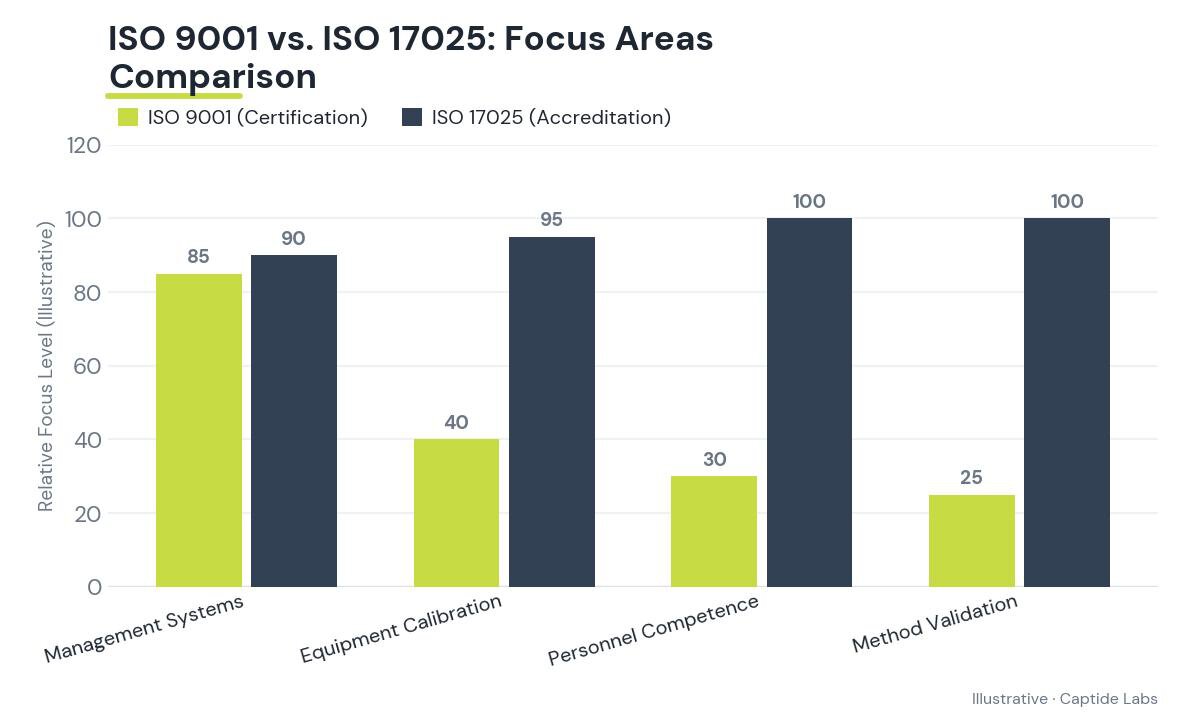
ISO 9001 is a quality-management-system standard that applies to any organization in any industry. It is intentionally general, focusing on management systems, customer requirements, and continual improvement. A company registers or is certified to ISO 9001. It is a valuable tool for running an organization, but on its own it does not contain the technical content needed to show that test, inspection, or calibration data are reliable.
ISO 17025 incorporates the essential management-system principles of ISO 9001 and then goes significantly further, adding the technical-competence requirements specific to testing and calibration laboratories. This is the crucial difference. An assessment against ISO 17025 evaluates both the management system and the technical competence of the laboratory, whereas an ISO 9001 audit addresses the management system alone.
The terminology reflects this. Laboratories are accredited to ISO 17025, not “certified.” The word accreditation is used deliberately, because it adds the concept of an independent accreditation body attesting to a laboratory’s technical competence for a specific scope of work, beyond mere adherence to a documented quality system. This is why the phrase “ISO 17025 certified” is technically incorrect, and why a claim that a product is “ISO 17025 certified” reflects a misunderstanding of what the standard covers. The accreditation attaches to the testing laboratory and its methods, never to the molecule in the vial. The International Organization for Standardization publishes the standard, while independent accreditation bodies perform the assessments.
What a Laboratory Must Do to Earn It
ISO 17025 accreditation is not a fee paid for a logo. A laboratory of any size that performs testing can pursue it, but the path is demanding. The lab must first prepare both its quality-management system and its technical operations to meet the standard’s guidelines, document its procedures for things like measurement uncertainty, method validation, and decision rules, conduct internal audits, and carry out management reviews. It then applies to an independent accreditation body, which performs a formal on-site assessment against the standard.
If the laboratory falls short during that assessment, it is typically given a defined window to correct the nonconformities. Failure to resolve them satisfactorily can mean the accreditation is withheld or lost until compliance is demonstrated. Accreditation is also not a one-time event: laboratories undergo regular surveillance audits to confirm they continue to meet the standard, so the credential reflects ongoing competence rather than a single good day years ago.
A particularly important ongoing requirement is proficiency testing. ISO 17025 requires accredited laboratories to participate in proficiency testing or interlaboratory comparisons relevant to their scope. In these programs, a lab analyzes samples and its results are compared against other laboratories or against established reference values, providing objective, external evidence that its measurements remain accurate over time. For a researcher, this means an accredited lab’s purity figure is not just internally checked but periodically validated against the wider analytical community.
Scope of Accreditation: Read the Fine Print
A detail that trips up many people is that ISO 17025 accreditation is scope-specific and site-specific. A laboratory is not accredited in the abstract for everything it might do; it is accredited for particular methods, at a particular facility, listed in a document called the Scope of Accreditation. That scope spells out exactly which tests and measurements the lab’s processes have been verified to perform competently.
This matters directly when reading a Certificate of Analysis. A lab might hold accreditation for some methods but not others, so the relevant question is not merely “is this lab accredited?” but “is the specific test on this certificate, such as HPLC purity determination or mass spectrometry identity confirmation, within the lab’s accredited scope?” A laboratory that describes itself as merely “ISO 17025 compliant” rather than accredited is another flag: compliance language suggests the lab may follow some of the standard’s practices without having submitted to the independent verification that accreditation requires.
In the United States, the American Association for Laboratory Accreditation (A2LA) is the leading accreditation body, while other countries have their own, such as UKAS in the United Kingdom and DAkkS in Germany. Each issues a certificate with a defined scope, and most maintain public directories where that scope can be confirmed.
What the Standard Actually Requires
It helps to understand, at least in outline, what a laboratory is being assessed against, because it explains why accreditation is more than a paperwork exercise. ISO 17025 is organized into two broad categories of requirements that a lab must satisfy together.
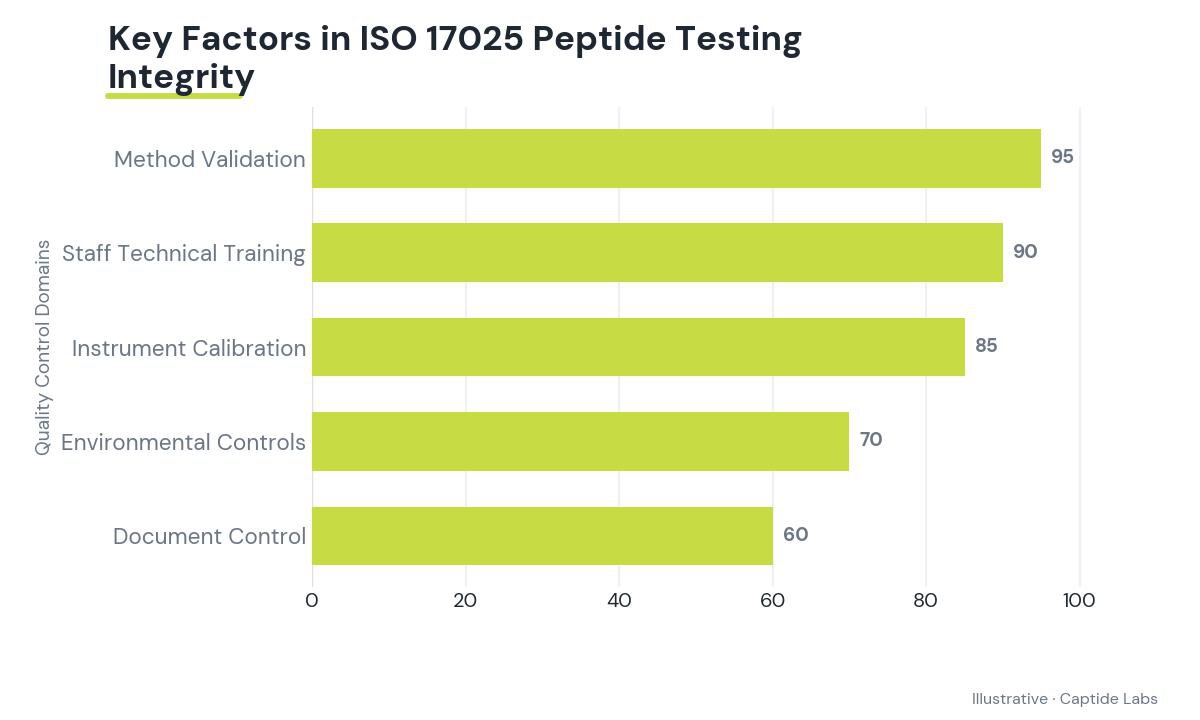
The first is technical requirements, which address the factors that determine whether a measurement is correct. These cover the competence and training of personnel, the suitability of the facilities and environmental conditions, the selection and validation of test methods, the calibration and maintenance of equipment, the traceability of measurements to recognized reference standards, and the formal estimation of measurement uncertainty. For peptide analysis, this is the machinery that ensures an HPLC purity figure or a mass spectrometry identity result is not just a number a machine produced, but a number generated by validated methods on calibrated instruments by trained analysts.
The second is management-system requirements, which address how the laboratory runs as an organization. These include document control, handling of complaints and nonconforming work, corrective actions, internal audits, and management reviews. A laboratory can satisfy this part either by maintaining a management system aligned with ISO 9001 principles directly, or by operating within an existing ISO 9001-certified system. This is the layer that ensures consistency over time, so that a result is reproducible and a problem, once found, is systematically fixed rather than quietly repeated.
Measurement uncertainty deserves a specific mention because it is something accredited reports often include and unaccredited ones rarely do. Every measurement has a margin of uncertainty, and a competent laboratory quantifies it rather than pretending a single number is exact. Seeing uncertainty addressed, alongside decision rules that state how the lab decides whether a result passes or fails a specification, is a sign you are looking at output from a genuinely rigorous process. Accreditation bodies translate the standard’s framework into the detailed checklists their assessors use on site.
Why It Matters for a Peptide COA
When a Certificate of Analysis names the laboratory that performed the testing, the presence or absence of ISO 17025 accreditation changes how much that document is worth. An accredited lab has been independently judged competent to run the methods it reports, which means a purity figure or a mass spectrometry result carries demonstrated technical backing rather than an unverified assertion. This is the difference between “we measured 99 percent” and “an independently assessed laboratory, competent in this method and subject to ongoing proficiency testing, measured 99 percent.”
Accreditation also reinforces the value of independence. A supplier testing its own products has an inherent incentive to report favorable numbers, even when acting in good faith. An accredited third-party laboratory operates under impartiality requirements that are formally assessed, removing that conflict of interest from the equation. For research where reproducibility depends on knowing exactly what compound was used, that separation is a meaningful safeguard rather than a marketing nicety. This is why the documentation for compounds like our TB-500 capsules and GHK-Cu capsules comes from an independent accredited facility, and every certificate is published on our COA and lab reports page rather than summarized secondhand.
The broader research community has been moving in this direction for years. Independent labs that re-verify supplier certificates report that a meaningful fraction show discrepancies on blind analysis, from overstated purity to mismatched identity. Accreditation does not make fraud impossible, but it raises the bar substantially, because an accredited lab stakes a formally assessed credential on the validity of its results.
Global Recognition Through Mutual Arrangements
A further benefit of ISO 17025 accreditation reaches beyond any single laboratory. Accreditation bodies participate in mutual recognition arrangements, coordinated internationally, so that results from an accredited laboratory in one country are accepted by organizations in another. The International Laboratory Accreditation Cooperation administers the arrangement that makes this cross-border recognition possible. In practice, this means an accredited COA carries weight globally rather than only locally, which is why accreditation is the common language of analytical trust across the entire testing industry, from peptide labs to calibration houses.
How to Verify an ISO 17025 Accreditation Claim
Because the term is used loosely, treat any accreditation claim as something to confirm rather than accept at face value. A genuinely accredited laboratory holds a certificate from a recognized accreditation body, and that certificate lists the specific scope of methods covered. Many accreditation bodies maintain public registries where you can confirm a laboratory’s status and scope directly. If a COA references accreditation but the issuing lab cannot be found in any such registry, or the named scope does not cover the test being reported, the claim does not hold up.
The practical questions are simple and worth committing to memory. Which laboratory performed the testing? Is it accredited, and by which body? Does its accredited scope include the methods on the certificate, such as HPLC purity and mass spectrometry identity confirmation? Is the lab independent of the supplier? Affirmative answers across all four give you a documented basis for trusting the numbers in front of you, whether you are evaluating a tissue-repair compound, a metabolic research peptide, or anything else in a research catalog.
Frequently Asked Questions
What is ISO 17025 accreditation in simple terms?
It is the main international standard confirming that a testing or calibration laboratory is technically competent, impartial, and consistent. A laboratory accredited to ISO 17025 has been independently assessed and verified to produce valid, reliable results for the specific methods in its accredited scope.
Is “ISO 17025 certified” the same as accredited?
No. Laboratories are accredited to ISO 17025 by an accreditation body, not certified. The term accreditation specifically denotes a third party attesting to technical competence. A product or peptide cannot be “ISO 17025 certified”; the accreditation applies to the testing laboratory and its methods.
What is the difference between ISO 17025 and ISO 9001?
ISO 9001 is a general quality-management-system standard for any organization. ISO 17025 incorporates those management principles and adds technical-competence requirements specific to testing and calibration laboratories. An ISO 17025 assessment evaluates both the management system and the lab’s technical ability to produce reliable results.
Why does ISO 17025 accreditation matter for a peptide COA?
It tells you the laboratory that measured purity and confirmed identity was independently judged competent to do so. This turns the numbers on a Certificate of Analysis from unverified claims into measurements backed by demonstrated technical competence and ongoing proficiency testing.
How do I verify that a lab is really accredited?
Check the accreditation body’s public registry for the laboratory’s status and Scope of Accreditation, and confirm that the specific test on the certificate (such as HPLC purity) falls within that scope. If the lab cannot be found or the scope does not cover the test, treat the claim with caution.
Final Thoughts
ISO 17025 accreditation is not a buzzword to skim past; it is a formal, independently assessed, continuously monitored credential that tells you a laboratory has proven it can produce valid, impartial, and consistent results. On a peptide Certificate of Analysis, an accredited testing laboratory transforms reported purity and identity from assertions into verifiable measurements backed by demonstrated competence and global recognition.
You can see what this looks like in practice on our COA and lab reports page, where every batch-specific certificate for products like our BPC-157 capsules comes from an independent accredited laboratory. To put the standard into the wider context of compound verification, read our guide on how to read a peptide COA, our breakdown of peptide purity testing methods, and our overview of why third-party testing matters for research peptides.
All products referenced are intended strictly for laboratory research use only and are not for human consumption, diagnostic, or therapeutic use. This content is educational and makes no health claims.